
ResearchAI
The next generation of AI research - where every answer comes with proof and every source is preserved forever.

Ask. Verify. Trust
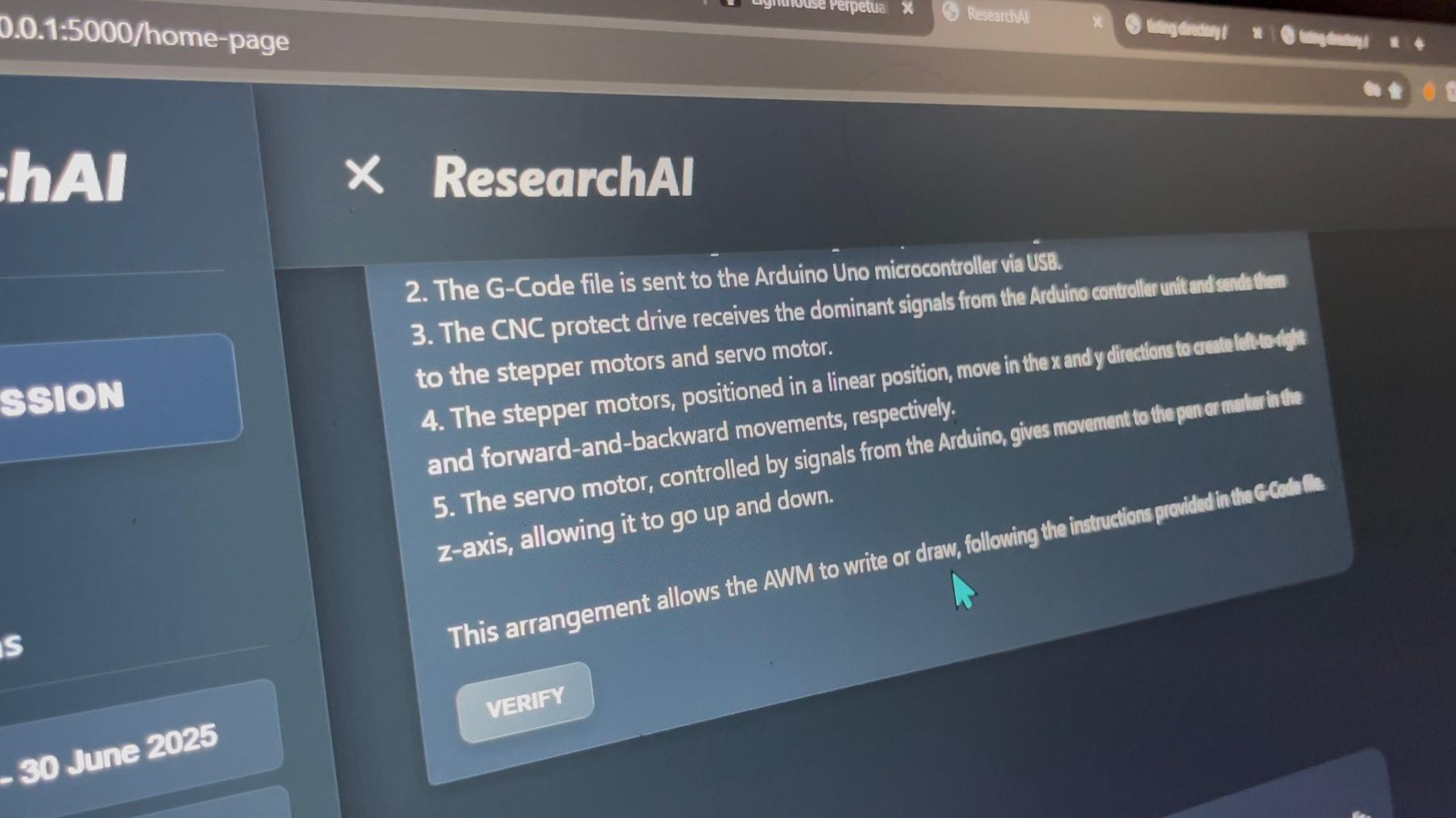
Every day, millions of people rely on AI systems for critical decisions – health advice, financial planning, scientific facts. Yet these systems operate like black boxes, delivering answers without showing their work. It's like having a brilliant researcher who refuses to share their sources.

Misinformation fills the vacuum. When people can't verify AI responses, they either believe blindly or reject entirely. False claims spread faster than corrections. Conspiracy theories flourish where truth should be accessible. People make life-changing decisions based on information they can't verify. Trust is breaking down. The choice shouldn't be between blind faith and total rejection. We need something better: verification.
Every AI response includes clickable links to peer-reviewed research papers. When we say "studies show meditation reduces anxiety," you see exactly which studies – complete with authors, publication dates, and journal names. Click any link and immediately access the full paper that supports our statement.

All research papers are stored on IPFS (InterPlanetary File System), creating permanent, tamper-proof records. Each paper receives a unique cryptographic hash – its digital fingerprint. If even one word changes, the hash changes too, making manipulation impossible.
We built our platform on peer-reviewed papers from top-tier journals and respected institutions. Every source is evaluated for credibility, methodology, and relevance. We prioritize recent studies, high-impact research, and rigorous peer review processes.
The problem isn't that AI is inherently untrustworthy – it's that we can't see its sources. Imagine if every AI answer came with links to the actual research it used. Imagine if you could verify every claim in seconds. Imagine if the world's scientific knowledge was finally accessible to everyone, not just academics behind paywalls.

We envision a world where artificial intelligence serves as humanity's most trusted research assistant – not because we ask you to believe it, but because you can verify everything it tells you. Imagine a future where breakthrough medical research reaches patients in plain language within days of publication, where students can explore complex scientific concepts with confidence, and where every professional decision is backed by accessible, verified knowledge. We're building the infrastructure that makes scientific discovery truly democratic, breaking down the barriers between academic research and everyday understanding.
The future belongs to accountable AI – systems that don't just process information, but preserve and present human knowledge with complete transparency. By connecting artificial intelligence to the permanent, decentralized web through blockchain technology, we're creating something unprecedented: an AI that gets smarter with every verified source added, more reliable with every citation checked, and more valuable as humanity's collective knowledge grows. This isn't just about building better AI – it's about building a more informed, more connected, and more truthful world where knowledge serves everyone, not just those with access to academic institutions.